
As you establish and scale your startup, you’ll use certificates of good standing to access services and opportunities to help you grow your business further.
But while requesting one of these certificates is easy, staying in good standing can be more of a challenge for some founders. Here, we’ll show you how to do both. Keep reading to learn:
- What is a certificate of good standing?
- Do I need a certificate of good standing for my startup?
- Where do I get a certificate of good standing?
- How to get a certificate of good standing
- Maintain your startup’s good standing with Warp
What is a certificate of good standing?
A certificate of good standing is a legal document that proves your company is legally registered and allowed to do business in your state.
Your state’s business filing agency will only give you one if your startup is in good standing. Good standing means you’re up-to-date on the state’s business requirements, including registration fees, taxes, and document filings.
Although most states call these documents certificates of good standing, you might also hear them referred to as:
- Certificate of existence
- Status certificate
- Certificate of authorization
- Certificate of status
- Certificate of compliance
Remember, though, that this is different from a certificate of tax compliance or clearance, which shows that a business has made all of its tax filings and payments to date.
Each state’s certificate of good standing will look slightly different, but they all include details like your business name, business entity type, the date you formed your business, and the state you’re authorized to do business in. Below is an example of what a certificate of existence from Oregon would look like.
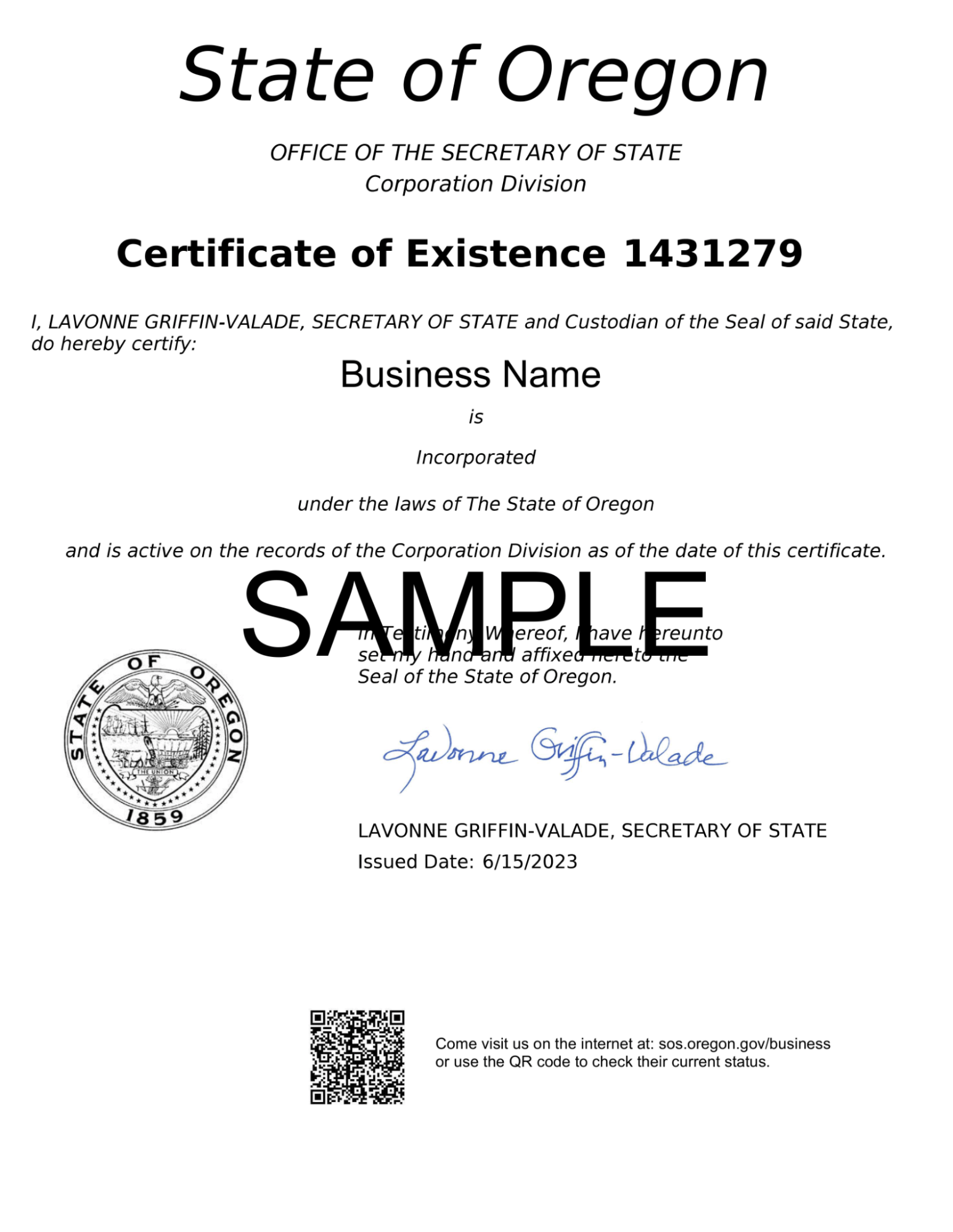
But as you’ll see in the following section, not all startups will need a certificate of good standing — and certain types of businesses can’t get one at all.
Do I need a certificate of good standing for my startup?
Having a certificate of existence isn’t required to run a business. And for the most part, you won’t need a certificate unless someone asks you to provide one. These situations include:
- Opening a business bank account
- Setting up a credit card processing system
- Applying for business loans or credit
- Seeking out investors or business partners
- Registering your business in a different state
- Getting business insurance
- Renewing business licenses and permits
- Selling your business
- Competing for government contracts
So, while you won’t necessarily need this document in your everyday operations, your ability to get one will be crucial in securing growth opportunities for your startup.
Only businesses that are required to register with their state can get a certificate of good standing. While this list generally includes limited liability companies (LLCs) and corporations, some partnerships, limited partnerships (LPs), and limited liability partnerships (LLPs) may be able to request one as well.
Registration requirements for partnership entities vary by state, so their ability to get a certificate of good standing will also depend on their state’s guidelines. If your business is organized as one of these entity types, check with your state’s business filing agency to learn if they offer certificates for your business type.
But whether your startup needs a certificate right now or not, keeping good standing with the state is still important. Failure to meet your state’s regulations can result in heavy fines and the loss of privileges like the right to use your business name, access to state courts, and even the ability to do business there.
Where do I get a certificate of good standing?
Eligible startups can get these documents from their state’s business filing agency or one of its subdivisions. In most states, the Secretary of State is the department handling this.
But because that’s not always the case, the chart below shows which agency to contact for a certificate of good standing in each state and any required filing fees.
| State | Business Filing Agency | Filing Fees |
|---|---|---|
| Alabama | Secretary of State | $28 |
| Alaska | Department of Commerce, Community, and Economic Development | $10 |
| Arizona | Arizona Corporation Commission | $10 |
| Arkansas | Secretary of State | $25 |
| California | Secretary of State | $5 |
| Colorado | Secretary of State | None |
| Connecticut | Secretary of State | $50 |
| Delaware | Division of Corporations | $50 for a short-form certificate $175 for a long-form certificate |
| Florida | Division of Corporations | $5 for LLCs $8.75 for corporations and partnerships |
| Georgia | Corporations Division | $10 |
| Hawaii | Business Registration Division of the Department of Commerce & Consumer Affairs | $7.50 |
| Idaho | Secretary of State | $10 |
| Illinois | Secretary of State | $25 for corporations and LLCs $5 for not-for-profit corporations |
| Indiana | Secretary of State | $15 for standard processing $26 for online processing |
| Iowa | Secretary of State | $5 |
| Kansas | Secretary of State | $15 for standard processing $10 for online processing |
| Kentucky | Secretary of State | $10 |
| Louisiana | Secretary of State | $15 |
| Maine | Bureau of Corporations, Elections & Commissions | $30 for corporations, LLCs, LPs, and LLPs $10 for nonprofit corporations |
| Maryland | Department of Assessments and Taxation | $20 |
| Massachusetts | Corporation Division of the Secretary of the Commonwealth of Massachusetts | $12 for corporations $25 for LLCs, LPs, and LLPs |
| Michigan | Corporations Division of the Department of Licensing and Regulatory Affairs | $10 |
| Minnesota | Secretary of State | $5 for standard processing $15 for online processing |
| Mississippi | Secretary of State | $25 |
| Missouri | Secretary of State | $10 |
| Montana | Secretary of State | $5 |
| Nebraska | Secretary of State | $10 |
| Nevada | Secretary of State | $50 |
| New Hampshire | Department of State | $5 |
| New Jersey | Division of Revenue and Enterprise Services of the Department of the Treasury | $25 for corporations, nonprofit corporations, and LPs $50 for short-form certificates for LLCs and LLPs $100 for long-form certificates for LLCs and LLPs |
| New Mexico | Secretary of State | $25 for LLCs $50 for corporations $10 for nonprofit corporations |
| New York | Division of Corporations, State Records, and Uniform Commercial Code | $25 |
| North Carolina | Department of the Secretary of State | $10 |
| North Dakota | Secretary of State | $20 |
| Ohio | Secretary of State | $5 for standard processing $25 for expedited processing |
| Oklahoma | Secretary of State | $20 |
| Oregon | Secretary of State | $10 |
| Pennsylvania | Department of State | $40 |
| Rhode Island | Department of State | $22 |
| South Carolina | Secretary of State | $10 |
| South Dakota | Secretary of State | $20 |
| Tennessee | Secretary of State | $20 |
| Texas | Secretary of State | $15 |
| Utah | Department of Commerce | $12 |
| Vermont | Secretary of State | $25 |
| Virginia | State Corporation Commission | $6 |
| Washington | Secretary of State | $20 |
| West Virginia | Secretary of State | $10 |
| Wisconsin | Department of Financial Institutions | $10 |
| Wyoming | Secretary of State | $10 |
How to get a certificate of good standing
If you’re short on time, companies like LegalZoom or Bizee can help you get a certificate of good standing for your startup. However, submitting a request for a certificate is a quick process that founders can easily do on their own. If this is the route you want to take, follow these steps.
Check if your startup needs to register with the state
Since only registered businesses can request a certificate of good standing, your first step should be to check your state’s business registration requirements. Generally, sole proprietorships don’t go through this process, while LLCs and corporations do. Business partnerships are subject to the regulations of each state.
If you need to register your startup but haven’t yet, do so before proceeding to the following steps.
Confirm your startup’s good standing with the state
Next, ensure that your startup meets all state regulations. These include filing your annual reports and other required documents, appointing a registered agent, and paying all taxes and fees.
If you’re unsure whether you’ve met these requirements, check your company's standing online. Business filing agencies maintain a database on their websites with information about every business registered in the state. Type your company’s legal name into the database to pull up your records. There, you’ll see your startup’s standing and whether you’re missing any requirements.
Request a certificate from your state’s business filing agency
Most states allow you to request a certificate of existence online, over the phone, in person, or by email, mail, or fax. Every state has its own guidelines and processes for requesting one of these documents, so you’ll need to visit your business filing agency’s website for the specific steps you need to take.
When you submit your request, you’ll also specify whether you’d like to receive your certificate of good standing electronically or by mail. Going the electronic route will allow you to download your certificate immediately after filing the request and paying the fee. Mailed certificates are delivered to your address a few weeks after filing.
Make sure your certificate of good standing meets your needs
All certificates of good standing have an expiration date, ranging from 30 days to one year after they’re issued, depending on the state that provides them. However, some organizations may need a document that has been issued recently — within the past 30 or 60 days, for instance.
So, ask your point of contact if they have any specific requirements for the document. And when you receive your certificate from the state, make sure it’s acceptable before filing any applications with it.
Maintain your startup’s good standing with Warp
A certificate of status can open your startup to a wealth of growth opportunities. Luckily, getting one of these documents is easy if you maintain good standing with your state.
Stay on top of your state’s requirements by using our software to automate as many of them as possible. Warp manages your startup’s state tax obligations and compliance documentation on one easy-to-use platform. Our software also automatically calculates and files your payroll taxes in every state you do business in, ensuring they’re filed accurately and on time.
Learn more about Warp’s comprehensive compliance features by requesting a demo today.